Hair Test Mineral Analysis FAQs
Yes — in many cases you can still complete the test.
Scalp hair is always our preferred option because it provides the most consistent and reliable results for Hair Tissue Mineral Analysis (HTMA). However, if you have very short hair, thinning hair, or are bald, we may be able to use body hair instead.
We will only accept:
- Pubic hair
- Chest hair (if suitable)
Other body hair is generally not suitable for testing.
It’s important to understand that body hair behaves differently from scalp hair:
- Minerals can appear more concentrated
- Growth rates differ
- The timeframe reflected may be longer than scalp hair
Mineral levels from alternative hair sources such as pubic or chest hair will often appear higher than levels from scalp hair. However, the mineral ratios — which are one of the most important aspects of the report when assessing overall health patterns remain consistent and still provide very valuable information.
Pubic hair can be particularly useful when assessing toxic elements and heavy metal exposure, as it may provide a stronger indication of toxic element accumulation in some individuals.
If you’re unsure whether your hair is suitable, please contact us before sending your sample and we’ll guide you.
The best place to collect your sample is from the back of the head, close to the scalp, around the nape/crown area. We recommend taking small snips from multiple areas rather than one obvious chunk so it remains discreet.
You only need the first 1–1.5 inches (3–4 cm) closest to the scalp, as this reflects the most recent mineral activity in the body.
We already have a video tutorial available on our website which demonstrates exactly how to collect your sample correctly.
When your test kit arrives, you’ll also receive:
- Written step-by-step instructions
- A scale guide showing exactly how much hair is needed
Following the instructions carefully helps ensure the most accurate results possible.
No — we do not wash hair samples at our laboratory.
This is because washing the hair after it has been cut can affect the mineral content, particularly water-soluble minerals, which may impact the accuracy of the results.
Instead, we ask that your hair is clean before you collect the sample. We provide clear instructions on how to prepare your hair prior to sampling to help ensure the most reliable results possible.
For best results, hair should be:
- Clean and dry
- Free from styling products
- Washed according to the instructions provided before sampling
By not washing the sample in the laboratory, we aim to preserve the integrity of the mineral content within the hair itself.
Typical timeline:
- Kit dispatched: typically, we dispatch on the day you place your order (if within normal working hours). Special delivery is available as an optional add-on for UK orders
- Return sample to the lab: a first class return envelope is included for UK orders and Royal Mail aim to achieve delivery within 1-2 days (although we have experienced delays unfortunately which is out of our control). For international orders, clients are responsible for arranging and paying for return postage of their hair sample. Delivery times will depend on the courier service used and customs clearance. In most cases there should not be customs charges to pay on hair samples, however if any customs fees or clearance charges are applied by the courier or customs authority, these would be the responsibility of the customer.
- Laboratory processing: approximately 7–10 working days once received
- Report preparation and interpretation: usually within a few days after lab completion
Results are generally available within 3 weeks.
Yes. Once your sample reaches us, you’ll receive a confirmation email so you know it has arrived safely. We then allow up to 3 weeks for results to be sent through.
Ideally, we prefer to test natural, untreated hair wherever possible. For the most accurate results, we recommend having at least 2cm of natural hair growth closest to the scalp.
If your hair has been dyed, there are still options:
- You may choose to wait until some natural regrowth is available
- Or you can let us know which dye or treatment has been used, and we can advise whether testing is suitable
If you decide to proceed with dyed hair:
- Your hair should have been washed at least three times since colouring
Some dyes and chemical treatments can affect mineral readings because they contain ingredients that may alter the mineral content of the hair.
For example:
- Henna-type dyes generally do not significantly affect results
- Fresh bleaching or strong chemical treatments are much more likely to impact accuracy
If your hair has been recently bleached or heavily chemically treated, we would usually recommend waiting and testing natural hair growth instead for the most reliable results possible.
However, if you provide us with details of the dye or chemical treatment used on your hair, we can review your results alongside this information and advise whether any mineral levels may have been influenced by the product used. Certain dyes and treatments are known to affect specific mineral readings more than others.
Your test kit includes a scale guide which helps you check whether you have provided enough hair for testing.
The laboratory requires:
- Approximately 125 milligrams of hair
Because everyone’s hair differs in thickness and weight, it’s more about the weight of the sample rather than the visual amount of hair itself. Fine hair will weigh differently from thick or coarse hair.
As a rough guide, this is usually:
- Around 1 heaped tablespoon of fine-cut hair
- Enough to gently tip the scale included in your kit
We strongly recommend watching the “How to Take Your Sample” video on our website, as this demonstrates:
- The correct amount of hair needed
- How to use the scale guide
- How the hair should be cut
- The best way to collect the sample
If we do not receive enough hair for testing, we will contact you to request an additional sample. Please note this will delay your results while we wait for the extra hair to arrive. You must send an additional sample within 3 months of our notification.
You need to return your hair sample within 6 months of ordering your test.
This gives you flexibility if you need to wait before collecting your sample — for example, if you have recently dyed, bleached, or chemically treated your hair and would prefer to allow some natural regrowth before testing.
Where possible, we recommend collecting natural, untreated hair for the most accurate results.
Yes. Mineral State uses a highly respected laboratory that follows strict quality control procedures and internationally recognised testing standards.
Hair Tissue Mineral Analysis is performed using advanced laboratory equipment designed specifically for mineral and trace element testing.
Hair Tissue Mineral Analysis (HTMA) is considered a well-established and robust method for assessing mineral balance and toxic element exposure over time. There are many published studies supporting the use of hair as a biological sample for evaluating both minerals and certain toxic elements.
Unlike blood testing, which reflects what is circulating in the bloodstream at a single moment in time, hair testing provides a longer-term picture of what the body has been depositing and excreting over weeks and months.
HTMA can provide valuable insight into:
- Mineral patterns and balances
- Stress patterns within the body
- Metabolic trends
- Toxic element exposure
- How mineral relationships may be influencing overall body function
As with any laboratory test, accuracy depends on:
- Correct sample collection
- Using a reputable and experienced laboratory
- Appropriate interpretation of the results and patterns
Unfortunately, we cannot guarantee an expedited laboratory turnaround time.
However, if you would like to receive your results as quickly as possible, we recommend:
- Selecting special delivery when ordering your kit
- Sending your completed hair sample back to us using a tracked or next day postal service
Once your sample arrives, we will send it to the laboratory as quickly as possible.
Although we cannot promise faster processing, using quicker postage methods may help reduce the overall turnaround time and you may receive your results sooner than our standard estimated timeframe of approximately three weeks.
Blood and hair measure very different things.
Blood tests show:
- What is circulating in the bloodstream at that exact moment
- What the body is tightly regulating for survival
Hair tests show:
- What the body is excreting or storing over time
- Longer-term mineral patterns and trends
It’s very common for blood and hair results to look different, and they often complement each other rather than contradict one another.
We send our test kits out as quickly as possible using First Class Royal Mail post.
Because the kit is sent in a standard-sized envelope rather than as a parcel:
- It will usually arrive with your normal daily post
- It should fit through a standard letterbox
- It may easily get mixed in with letters and other paperwork
Please check carefully before assuming it hasn’t arrived, as many people are expecting a parcel rather than an envelope.
Unfortunately, we do occasionally experience delays with Royal Mail, so your kit may take a few extra days to arrive.
Please note:
- Standard First-Class post is not tracked
- Tracking is only available if you selected a special delivery option at checkout
If your kit still hasn’t arrived after a reasonable amount of time, please contact us and we’ll arrange to send a replacement kit out to you.
For international orders, kits are sent using a tracked postal service. Once your test kit has been dispatched, you will receive your tracking information.
No. Special delivery applies to the shipment of the kit to you only.
Your test kit includes a prepaid return envelope, which is sent using First Class Business Mail.
However, this is not a guaranteed next day or special delivery return service.
If you would like your completed sample to arrive with us as quickly as possible, we recommend upgrading the return postage yourself using:
- Royal Mail Special Delivery
- A tracked next day postal service
Any upgraded return postage is the responsibility of the customer.
The kit comes in a standard sized white envelope and is designed to fit through a standard letterbox.
At the moment, we’re unable to offer discounts for multiple tests, as there is a fixed cost associated with processing each individual test.
However, we do occasionally run special offers and promotions. If you are subscribed to our mailing list, we’ll make sure you’re the first to hear about any upcoming discounts or offers.
We commonly see low iodine levels reported on HTMA results.
Low iodine is very common in many parts of the world, including the UK, due to factors such as:
- Modern food processing methods
- Reduced iodine levels in soil
- Agricultural practices and fertilisers
- Exposure to substances that may interfere with iodine utilisation
Because of this, iodine is never interpreted in isolation.
When reviewing iodine levels, we also consider:
- Symptoms
- Thyroid health
- Other mineral patterns and ratios
- Overall metabolic trends
- The wider clinical picture
If iodine balance is something you are particularly concerned about, professional interpretation is strongly recommended, as further support and investigation may sometimes be needed.
This can happen during mineral balancing and detoxification.
As the body begins shifting minerals and toxic elements, some previously hidden patterns may become more visible on later tests. This does not necessarily mean “new exposure” — sometimes the body is simply beginning to eliminate or redistribute stored elements.
Most people retest every:
- 3–6 months when actively following a protocol
- 6–12 months for general monitoring
Retesting too soon is usually not recommended because mineral patterns take time to shift.
Not necessarily. As long as there is enough hair close to the scalp, you can still provide a sample.
If your hair is extremely short after the cut, it may be better to wait a few weeks for regrowth or submit a pubic hair sample instead. Note that you must send a sample within 6 months of ordering your test kit.
Usually yes, provided:
- The sample has been stored cleanly and dry
- It hasn’t been contaminated with products
- It’s been kept in paper, not plastic
Please avoid:
- Plastic bags
- Foil wrapping
- Damp storage
Paper envelopes are best.
Hair is very stable and can usually still be tested months after being cut if stored correctly in a dry paper envelope.
Yes. Hair samples remain stable for a long time if stored properly in a dry paper envelope.
We recommend:
- Avoiding medicated shampoos (anti-dandruff types) 1 week before collection
- Avoiding styling products 2 days before sampling
- Avoiding dyes or bleaches
- Ensuring hair is clean and dry (we recommend using a baby shampoo to wash your hair before cutting)
You do not usually need to stop supplements unless specifically advised.
No. Gloves are not usually necessary.
Simply ensure:
- Hands are clean
- Scissors are clean
- The sample stays dry and uncontaminated
Your HTMA report includes clear guidance so many people choose to start by using the report themselves to make positive changes and improvements.
However, if you would like additional support or a deeper understanding of your results, there are several further options available:
1. Use the report independently
Your report contains:
- Dietary guidance
- Lifestyle recommendations
- Information about your mineral patterns and ratios
This can be a great starting point if you feel confident making your own changes.
2. Purchase a personalised video interpretation
With this option, your results are explained in a recorded personalised video where our nutritionist will:
- Go through your mineral patterns in detail
- Explain what the results may mean
- Highlight key areas to focus on
- Help you understand the bigger picture behind the report
Many clients find this easier to follow than reading the report alone.
3. Book a 1:1 Zoom consultation
A Zoom consultation allows you to:
- Discuss your results live
- Ask questions directly
- Explore symptoms and concerns in more detail
- Receive more personalised guidance from our nutritionist
4. Book a consultation package
If you have more complex health concerns or would like ongoing support, a consultation package may be the best option.
This includes:
- A full health and case history review
- Tailored nutrition support
- Supplement guidance
- Lifestyle recommendations
- Ongoing support over a period of time
This option allows you to work closely with our nutritionist in much greater depth to support your overall health and wellbeing.
A personalised video interpretation allows you to:
- Understand your results in plain English
- Learn what the patterns may mean for your symptoms
- Hear the “big picture” rather than focusing on isolated numbers
- Receive more practical guidance and context
Many clients find the video far easier to understand than reading the report alone.
A Zoom call is designed to help you better understand your HTMA report and what the findings may mean for you personally.
During the session, our nutritionist will:
- Talk you through your report in clear, easy-to-understand language
- Discuss the main mineral patterns and ratios
- Relate the findings back to the symptoms or concerns that led you to do the test
- Explain how certain mineral imbalances may be influencing how you feel
- Discuss practical diet, lifestyle, and nutritional approaches that may help support better mineral balance
One of the biggest benefits of the Zoom call is that it happens in real time, allowing you to:
- Ask questions throughout
- Get clarification on anything you don’t understand
- Discuss your results in a more personal and interactive way
Please note that this is not a full nutritional consultation or full case review. If you are looking for more in-depth ongoing support, tailored supplement protocols, or a comprehensive health assessment, a consultation package would be more suitable.
Yes — we regularly carry out Hair Tissue Mineral Analysis (HTMA) for children.
We generally recommend testing from around 12 months of age onwards, provided there is enough hair available to collect a suitable sample.
Because children’s hair — especially baby hair — is often extremely fine, it’s important to make sure enough hair is collected to meet the required sample weight.
As long as you are able to provide a sufficient sample, we can test children from one year old.
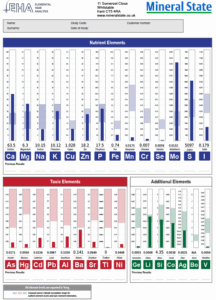
| Element Name | Element Symbol |
|---|---|
| Arsenic | As |
| Mercury | Hg |
| Cadmium | Cd |
| Lead | Pb |
| Aluminium | Al |
| Barium | Ba |
| Strontium | Sr |
| Thalium | Tl |
| Nickel | Ni |
| Element Name | Element Symbol |
|---|---|
| Calcium | Ca |
| Magnesium | Mg |
| Sodium | Na |
| Potassium | K |
| Copper | Cu |
| Zinc | Zn |
| Phosphorus | P |
| Iron | Fe |
| Manganese | Mn |
| Chromium | Cr |
| Selenium | Se |
| Molybdenum | Mo |
| Sulphur | S |
| Iodine | I |
| Element Name | Element Symbol |
|---|---|
| Germanium | Ge |
| Lithium | Li |
| Silicon | Si |
| Cobalt | Co |
| Silver | Ag |
| Boron | Bo |
| Vanadium | V |