If you’ve been researching Hair Tissue Mineral Analysis (HTMA), you may have come across very different opinions about it.
So, is HTMA testing reliable?
The short answer is that minerals and elements in hair can be accurately measured when appropriate analytical methods and laboratory quality controls are used. There is scientific research supporting the use of hair as a biological sample for elemental analysis, including its use in toxicology, environmental monitoring, biomonitoring and forensic science.
However, as with any laboratory test, the quality of the laboratory, how the sample is collected and how the results are interpreted all matter.
I’ve used HTMA throughout more than 25 years of working in nutritional therapy, and for me it remains an incredibly valuable nutritional assessment tool – when it’s used appropriately.
What does an HTMA actually measure?
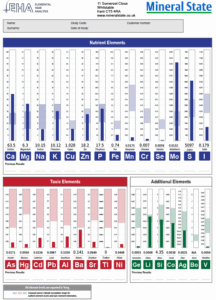
Hair Tissue Mineral Analysis measures the concentration of nutritional minerals, trace elements and certain potentially toxic elements within a sample of hair.
As hair grows, elements are incorporated into its structure. Modern laboratory techniques can then measure these elements at extremely low concentrations.
This gives us an important distinction when talking about the reliability of HTMA:
What does the science say?
There is a substantial body of published research into elemental analysis of human hair, covering sampling, analytical techniques, accuracy, quality assurance, reference ranges and applications in areas such as toxicology and environmental monitoring.
Research has demonstrated that good laboratory practice – including method validation, quality control and proficiency testing – can produce analytically reliable measurements of trace elements in hair.
Hair is particularly well established as a biomarker for certain exposures. Mercury is a good example. The World Health Organisation recognises hair as a useful biomarker of longer-term methylmercury exposure.
So the principle of using hair as a biological sample to measure elements is well established.
Where we need to be more careful is in what those measurements mean and how we interpret them.
Why the laboratory matters
Some of the controversy surrounding HTMA originates from studies that found differences when the same hair samples were sent to different commercial laboratories.
Rather than demonstrating that minerals can’t be measured in hair, this highlights something I believe is fundamental:
Not all hair analysis is necessarily the same.
Laboratories can differ in their analytical equipment, sample preparation, quality-control procedures and reference data.
This is why I’m particularly careful about the laboratory we use at Mineral State.
Our samples are analysed by a fully quality-assured specialist laboratory using highly sensitive analytical equipment capable of measuring nutritional minerals, trace elements and potentially toxic elements at very low concentrations.
The laboratory also uses current reference data, which was particularly important to me when choosing who we work with. Laboratory technology and our understanding of mineral patterns have moved forward enormously over the years, and I want the testing we offer today to reflect that.
Does our laboratory wash the hair?
This is something I’m asked about frequently.
No. Our laboratory does not wash the hair before analysis.
Washing hair samples is a debated area within elemental hair analysis. Although washing may remove some external material, depending on the method used it can also potentially alter the elemental composition of the hair itself.
Our laboratory therefore uses a consistent non-washing protocol.
This makes good sample collection particularly important. We provide clear instructions explaining where and how to take the sample, and factors such as hair colouring, bleaching, swimming and certain hair products may need to be considered when interpreting a result.
Good HTMA relies on good sampling, high-quality laboratory analysis and appropriate interpretation.
Why might hair and blood results be different?
One of the most important things to understand about HTMA is that hair and blood are different tissues and they don’t necessarily tell us the same thing.
For example, a low hair magnesium result doesn’t automatically mean someone is medically magnesium deficient. Equally, a mineral may look very different in the hair from the way it appears in the blood.
That doesn’t automatically make either result wrong.
Blood testing tells us about what’s circulating in the blood, whereas HTMA measures elements incorporated into the hair as it grows.
Sometimes it’s actually the difference between the two that prompts us to ask further questions.
This is why I see HTMA and blood testing as complementary rather than competing tests. If I need to assess thyroid hormones, iron status or blood glucose, for example, I still want the appropriate blood investigations.
HTMA gives me another piece of the nutritional picture.
What makes HTMA so useful?
After more than 25 years of using HTMA, what interests me most isn’t one individual mineral.
It’s the pattern.
I look at minerals including calcium, magnesium, sodium, potassium, zinc, copper and iron, together with the trace minerals and potentially toxic elements.
I then look at the relationships between them.
Some of the key ratios we consider include:
Sodium to potassium
Calcium to magnesium
Calcium to potassium
Sodium to magnesium
Zinc to copper
Iron to copper
Calcium to phosphorus
These relationships can give us additional clues around areas such as metabolic patterns, stress and resilience, blood sugar regulation, hormone and neurotransmitter pathways, iron utilisation and immune function.
The potentially toxic elements are also important because they can interact with essential minerals and form another part of the overall picture.
Depending on the type of interpretation being undertaken, I can then put those findings alongside the person’s age, life stage, diet, supplements, lifestyle, symptoms, health history and other test results.
That’s where the real value of HTMA lies for me – not in one high or low result, but in the story the minerals begin to tell when we look at them together.
Can HTMA diagnose thyroid problems, adrenal problems or diabetes?
No. HTMA is a nutritional assessment tool rather than a medical diagnostic test.
Within HTMA, you may see mineral relationships referred to as the “thyroid ratio”, “adrenal or stress ratio” or “blood sugar ratio”.
These don’t directly measure thyroid hormones, adrenal hormones or blood glucose. Instead, the minerals involved participate in physiological pathways relevant to these areas, and their relationships can provide useful clues about patterns that may warrant closer attention.
This can be particularly interesting when somebody is experiencing symptoms but their conventional blood results remain within reference ranges.
Where appropriate, HTMA findings can therefore help us decide what we might want to investigate further, rather than being used to make a diagnosis themselves.
What about heavy metals and toxic elements?
HTMA can also measure potentially toxic elements including mercury, lead, cadmium, arsenic and aluminium.
Hair analysis has been widely studied in this area and has practical advantages because it’s non-invasive, easy to collect and can provide information relating to exposure over time.
However, different elements behave differently, so an isolated high result shouldn’t automatically be interpreted as proof of toxicity.
We consider possible exposure sources, the wider mineral pattern and sampling factors, and whether further investigation is appropriate.
Why retesting can be so useful
One of the aspects of HTMA I find particularly valuable is the ability to look at trends over time.
When somebody retests after several months, we’re not simply asking whether individual numbers have moved into the reference range.
We’re looking at the whole pattern.
Have sodium and potassium changed? What has happened to calcium and magnesium? Has the zinc-to-copper relationship shifted? Are the key ratios changing? What has happened to the toxic elements?
Why I continue to use HTMA
I’ve worked as a nutritional therapist for over 25 years and have used Hair Tissue Mineral Analysis throughout my career.
If I didn’t find it useful, I wouldn’t still be using it.
I love that such a simple, non-invasive test can provide us with so much information. It’s particularly valuable when working with children, where blood testing can sometimes be difficult or stressful.
But most importantly, HTMA gives me a different perspective.
It doesn’t replace blood testing or medical investigation. It allows us to look at mineral patterns, relationships and trends, and to use those findings alongside everything else we know about the person.
The bottom line: Is HTMA reliable?
Yes – minerals and elements within hair can be reliably measured when appropriate analytical methods, quality controls and laboratory procedures are used.
The important distinction is between obtaining an accurate laboratory measurement and deciding what that measurement means.
HTMA shouldn’t be used in isolation to diagnose a medical condition. Its value lies in looking at patterns, mineral relationships and trends, putting them into context and using that information to identify areas that may benefit from nutritional support or further investigation.
Combine that with a high-quality laboratory, current reference data and experienced interpretation, and HTMA can provide an incredibly useful additional piece of the nutritional picture.
Related articles:
→ What is HTMA? A Guide to Hair Tissue Mineral Analysis
→ Understanding HTMA Mineral Ratios: What Do They Mean?
→ HTMA vs Blood Tests: What’s the Difference and Why Can Both Be Useful?