One of the questions I’m frequently asked about Hair Tissue Mineral Analysis is: ‘Why do I need a hair test if I’ve already had blood tests?’
It’s a very good question – and the simple answer is that blood testing and hair mineral analysis aren’t trying to tell us exactly the same thing.
I use both in nutritional therapy because they can provide different pieces of the puzzle.
Blood tests are a snapshot in time.
A blood test gives us information about what’s circulating within the bloodstream when that sample is taken.
Blood testing can be incredibly valuable and is essential for diagnosing and monitoring many medical conditions.
Depending on what’s being investigated, blood tests may include glucose and HbA1c, cholesterol, iron markers, vitamin B12, folate, vitamin D, thyroid hormones, liver and kidney markers, inflammation markers and full blood count.
Think of your blood as the store cupboard.
I often explain the difference using a kitchen analogy.
Imagine you’re about to cook a meal. You open your store cupboard and look at all the ingredients available to you.
That’s a little like looking at the blood.
It can help us answer: ‘What ingredients are available?’
But knowing what’s in the cupboard doesn’t necessarily tell you what meal is being made.
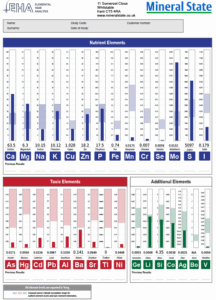
HTMA gives us a different part of the picture.
Hair grows over time, and minerals and other elements are incorporated into the hair during that process.
This means HTMA provides a different type of information from a blood sample taken at one particular moment.
When I interpret an HTMA, I’m looking at the pattern – calcium and magnesium, sodium and potassium, zinc and copper, and how those relationships change over time.
If blood is helping us look at the ingredients available, I think of HTMA as helping us explore what’s happening with those ingredients over time.
The ‘before, during and after’ picture
Another way I sometimes explain nutritional testing is to think of it as before, during and after.
Blood – the ‘before’: what is circulating and available at the time of testing.
Hair – part of the ‘during’ picture: minerals and elements incorporated into growing hair, interpreted as patterns alongside diet, lifestyle, symptoms and other test results.
Urine – part of the ‘after’ picture: depending on the test, urine can measure substances being excreted from the body.
Rather than expecting blood, hair and urine to produce identical results, I see them as different windows into what’s happening within the body.
Why might my blood and hair mineral results be different?
Someone may have a mineral within the normal range on a blood test but see a very different pattern on their HTMA.
That doesn’t automatically mean that one of the tests is wrong. Blood and hair are different tissues, and the tests measure different things.
Iron is a good example. Someone might have low iron markers on a blood test but a relatively high iron result on their HTMA. At first glance, that can seem contradictory – how can iron be low in one place and high in another?
This is where we need to look beyond simply asking whether someone has “enough” iron. We also need to consider how iron is being transported, handled and utilised by the body. Copper, for example, plays an important role in normal iron transport and metabolism, which is why I also pay attention to the relationship between iron and copper on an HTMA.
What about blood sugar?
Blood sugar provides a good example of why looking at different information can be useful.
If we want to know your blood glucose level, we measure blood glucose. If we want an indication of average blood glucose over the preceding few months, HbA1c can be extremely useful.
HTMA doesn’t measure blood glucose and it cannot diagnose diabetes or prediabetes.
However, within HTMA interpretation we also look at mineral relationships traditionally associated with aspects of glucose regulation – including the calcium-to-magnesium ratio, often referred to as the blood sugar ratio.
I think of these patterns as clues rather than diagnoses.
Can HTMA predict future health problems?
An HTMA can’t tell you that you’re going to develop a particular disease.
What it can do is identify mineral patterns and trends that may be worth addressing.
This becomes particularly interesting when HTMA is repeated and we can see how those patterns are changing over time.
So, is HTMA better than blood testing?
No – and blood testing isn’t better than HTMA either. They serve different purposes.
If I suspect anemia, I want appropriate blood investigations. If I’m concerned about thyroid function, I want thyroid blood markers. If someone has symptoms suggestive of poor blood sugar control, appropriate glucose and HbA1c testing may be required.
HTMA doesn’t replace any of those.
But if I want to explore someone’s broader mineral pattern, relationships between minerals and how those patterns change over time, Hair Tissue Mineral Analysis can provide another useful piece of information.
It’s not about choosing one test over another. It’s about choosing the right test for the question we’re trying to answer.
Related reading: