If you’ve been looking into mineral testing, nutritional health or ways to understand what’s happening within your body, you may have come across the term HTMA.
But what exactly is HTMA, what does it test for, and what can your hair really tell us?
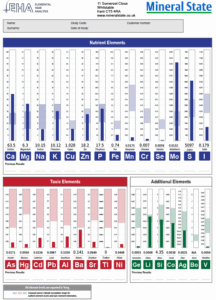
HTMA stands for Hair Tissue Mineral Analysis. It is a simple, non-invasive laboratory test that measures the levels of minerals and certain toxic elements found within a small sample of hair.
I’ve been using HTMA in my nutritional therapy practice for many years.
Why HTMA has always been part of my work
I’m Julie Clark, a Registered Nutritional Therapist and the owner of Mineral State.
I’ve worked in nutritional therapy for over 25 years and have used Hair Tissue Mineral Analysis throughout my career. Long before I became the owner of Mineral State, HTMA was a test I regularly used with my own clients because I found the information it provided so useful.
One of the things that initially attracted me to HTMA was its simplicity. It doesn’t involve needles, a blood draw or a visit to a clinic – just a small sample of hair that can be collected at home and sent to the laboratory for analysis.
That has made it particularly useful in my work with children. I’ve worked with many children over the years, and being able to gather useful nutritional information without putting a child through an invasive test can be a real advantage.
But the reason I’ve continued using HTMA for so long goes much further than convenience.
I love the amount of information we can gain from such a simple test. It can often feel like the missing piece of a puzzle, especially when you know something isn’t right but your tests with the GP are all coming back within range.
HTMA gives us a window into what’s happening at a deeper level. Minerals are at the heart of so many processes in the body – they help our cells produce energy, communicate, respond to stress and carry out their everyday functions. HTMA allows us to look at individual minerals, but more importantly at how those minerals are working in relation to one another. When we put those pieces together, we can start to see patterns that give us clues about how the body is functioning and where it may need additional support.
Over the years, I’ve also found retesting particularly valuable. Being able to compare results after several months can help us see how someone’s mineral pattern is changing and whether the nutritional and lifestyle changes they’ve made are moving things in the right direction.
My involvement with HTMA eventually led me to become the owner of Mineral State, where my focus has been on making Hair Tissue Mineral Analysis accessible and, importantly, understandable.
Because receiving pages of laboratory numbers isn’t particularly helpful if you don’t know what they mean.
That’s why we’ve put so much work into the Mineral State reports – bringing together the laboratory findings with clear explanations to help you understand your mineral patterns and what you can practically do with that information.
So, what does an HTMA actually measure?
Minerals are involved in almost every process within the body. They contribute to energy production, nervous system function, bone health, hormone function, antioxidant protection and many other processes.
An HTMA measures a range of nutritional minerals and certain potentially toxic elements found within the hair.
But while the individual results are important, one of the most interesting aspects of HTMA is looking at how those minerals relate to one another.
This is where the test starts to become particularly useful.
Related article: